
Specialty Media Office Printers: Real Cost Analysis
By Priya Natarajan • 6th May
Introduction
When procurement asks for a quote on specialty media office printers that can handle transparencies, fabric transfers, or metalized stock, the per-unit price often looks reasonable. Then the spreadsheet lands on finance, and questions multiply: What happens when the specialty feed module jams? For common label, envelope, and cardstock issues, see our specialty media troubleshooting guide. Who pays for the proprietary film cartridges? How much will drift across three sites over five years? The reason these questions matter is that transparency printing comparison across vendors demands more than a feature checklist, it requires scenario analysis of real operational patterns, supply continuity assumptions, and contract language clarity. I've seen procurement teams select a bargain-tier system only to discover mid-cycle that specialty media compatibility meant emergency vendor service calls, reprinting cycles that bloated page counts, and a hidden toner/consumables tax that dwarfed the original savings. The cheapest fleet is the one that stays predictable for its entire life, and with specialty media handling, predictability becomes a series of explicit line items, not a hope.
FAQ: Specialty Media Printer Cost Reality
What Are Specialty Media Office Printers, and Why Do They Cost More Than Standard Models?
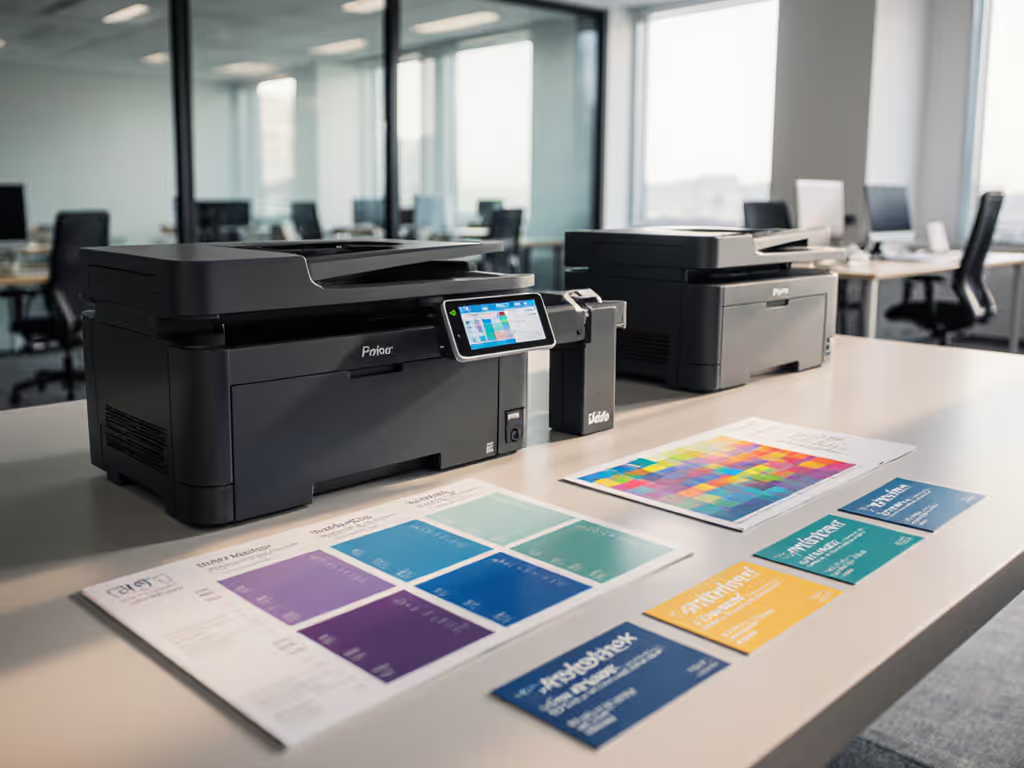
Specialty media printers are engineered to process non-standard substrates: transparencies, fabric transfers, label stock, cardstock, and metalized papers. Unlike commodity models optimized for copy-grade bond, these systems feature:
- Precision feed mechanisms (sometimes dual or variable)
- Heated fuser sections or post-print finishing stations
- Firmware configured for slower feed rates on thicker substrates
- Module locks or drivers that enforce media-type selection
The upfront cost premium typically ranges 15-40% over equivalent-volume standard machines, but the real cost multiplier emerges in the consumables, service overhead, and retry cycles. A specialty media device that jams twice monthly on certain paper stocks doesn't just waste sheets (it stalls workflows, triggers help desk tickets, and creates a compounding expectation of downtime that standard fleets avoid). Additionally, fabric printing capabilities and metalized paper handling require either proprietary ink formulations or toner cartridges with different composition, which means your standard supply chain breaks. Vendors know this dependency and price accordingly.
How Does Specialty Media Handling Change the Total Cost of Ownership (TCO) Calculation?
TCO for specialty media systems must include a sensitivity analysis layer absent from standard printer budgets. Here's the line-item breakdown you'll typically encounter:
- Base hardware: Lease or purchase price (often 3-5 year terms)
- Standard consumables: Black and color toner (monthly estimates plus overage per-page rates)
- Specialty cartridges or media-feed kits: Separate line items, often vendor-proprietary with 8-12 week lead times
- Maintenance contracts: Higher per-call rates and often tiered SLAs for systems outside standard support
- Overages: Per-page overages apply when volumes exceed the negotiated threshold; specialty media usage typically spikes unpredictably
- Downtime costs: Unmeasured but real: a three-day supply backorder on specialty ribbon or a firmware update that breaks fabric-transfer mode
- Recycling/cartridge disposal: Specialty cartridges often incur higher disposal fees or vendor lock-in (can't use third-party remanufactured toner)
Total cost counts every jam, callout, and empty shelf. For a complete framework on modeling long-term expenses, see our total printer ownership cost guide.
Once you layer in retry cycles (reprinting failed specialty jobs), supply chain delay penalties, and the probability of a cold-start learning curve when a new operator feeds metalized stock incorrectly, the 15% hardware premium can easily inflate to a 30-50% total lifetime cost premium over five years. The teams that avoid this trap do so by separating specialty media devices into dedicated queues with documented workflows and isolated troubleshooting, rather than attempting a one-size-fits-all solution. To operationalize this separation, follow our printer queue management best practices.

What Contract Language Should You Insist On for Predictable Specialty Media Costs?
Vendors will offer either a pooled per-page rate (blended standard and specialty) or a tiered structure (e.g., $0.05/page for black, $0.15/page for color, $0.25/page for specialty media output). Neither is neutral; both require contract scrutiny:
Pooled Rate Risk: If 30% of your output is specialty media at 3x the base cost, but the contract quotes a simple blended rate, you're exposed to a forecast miss. A 20% volume spike in specialty campaigns could push you into an overage tier with punitive per-page fees ($0.40-$0.60 per specialty page is not uncommon).
Tiered Rate Clarity: Insist on explicit definitions of what counts as specialty media output.
Related Articles