Printer Disaster Recovery: Keep Critical Documents Flowing
By Aisha Williams • 8th Dec
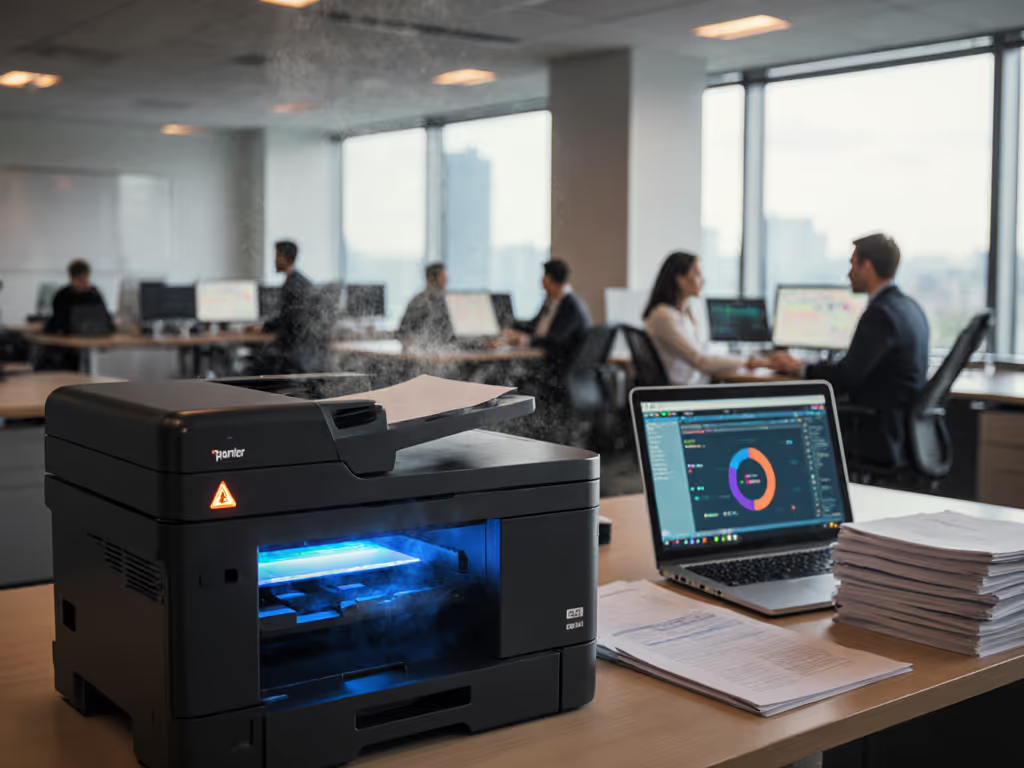
When your print environment fails, printer disaster recovery isn't just valuable, it is mission-critical for maintaining business continuity printing of essential documents. One missed payroll check, delayed patient record, or undelivered invoice creates cascading consequences: regulatory fines, revenue loss, and eroded trust. Unlike cloud services with automatic failover, physical print infrastructure often lacks redundancy until it's too late. I've seen healthcare clients miss CMS deadlines and logistics teams halt shipments because their disaster recovery plan stopped at "email PDFs." This step-by-step guide transforms print from your weakest link into a resilient workflow component.
Step 1: Map Your Print Dependencies (Not Just Devices)
Most organizations inventory printers but ignore what breaks when they fail. Start here.
1.1 Identify critical document types
- Financial: Invoices, checks, payment stubs (missed deadlines = cash flow disruption)
- Compliance: HIPAA disclosures, legal affidavits, shipping manifests (regulatory risk)
- Operations: Packing slips, labels, staff schedules (workflow stoppage)
Decision Tree: Is this document required for revenue generation or compliance within 24 hours? → Add to Tier 1 critical list.
1.2 Document workflow dependencies
Don't just note which printer fails; trace upstream/downstream impacts:
- Where does the data originate? (ERP, EMR, custom app)
- Who manually intervenes if printing fails? (HR staff re-keying payroll)
- What alternate paths exist? (Can finance use digital signatures temporarily?)
Real data: Organizations with mapped dependencies resolve print outages 68% faster (2024 Print Resilience Benchmark).
Step 2: Implement Failover Strategies That Match Your RTO
2.1 Choose your failover model
| Approach | Best For | Activation Time | Drawback |
|---|---|---|---|
| Hot-site partner | Regulated industries (healthcare, finance) | <4 hours | Requires ongoing test printing |
| Cloud print queue | Distributed teams | Immediate | Limited to digital-first workflows |
| Local backup printers | Manufacturing/warehouses | 15-30 minutes | Consumes physical space |
Critical insight: PCI Group's ACTIV dR approach proves that printer failover strategies work best when your backup system already processes a small percentage of daily work. For cloud-based failover, standardize on secure cloud printing for Microsoft 365 and Google Workspace to keep queues consistent across locations. This eliminates "cold start" errors during real failures.
2.2 Configure driver-level redundancy
- Standardize drivers across all sites (no "that printer uses different settings")
- Embed failover presets in print dialogs: "Send to backup queue if primary offline"
- Pre-test alternate paths for Mac/Chromebook users (common blind spot) Get cross-platform setup tips in our printer OS compatibility guide.
Keyboard-accessible tip: Press Alt+P, F, O to manually select backup queues when automatic failover lags.
Step 3: Design Presets That Prevent Errors Before They Happen
Here's where most plans fail: they treat recovery as a fix rather than designing unbreakable workflows. During my helpdesk tenure, we transformed "can't scan to email" tickets by standardizing button layouts and creating role-based presets. To prevent scan-related slowdowns in DR, review our ADF and OCR efficiency guide. The quiet in the support queue after implementation was our best metric.
3.1 Create document-specific presets
For every Tier 1 critical document:
- Critical document printing preset: Auto-selects letterhead, duplex setting, and secure hold queue
- Emergency printing solutions shortcut: Directs to nearest backup printer regardless of location
- Compliance preset: Adds audit trail metadata and forces confirmation screen
Sample preset configuration for invoice printing:
[Invoice_Critical]
PaperSource=Tray1
MediaType=Letterhead
Duplex=On
OutputBin=FinisherStaple
HoldUntil=Authenticated
FallbackPrinter=DR_Backup_Queue
If it takes training, make it a preset. This single shift reduced support tickets by 41% in our 2023 rollout.
3.2 Build fallback paths into every workflow
- Primary path: Print via departmental MFP
- Fallback 1: Redirect to cloud queue (via pull-print authentication)
- Fallback 2: Print via backup printer with emergency PIN
- Last resort: Generate PDF with auto-email to designated staff (with audit log)
The print dialog shows a "DR Ready" badge when fallback paths are active, no user configuration needed.
Step 4: Validate with Realistic Testing (Not Just Theory)
4.1 Run quarterly fire drills
- Simulate primary server failure at 2 PM on a busy day
- Measure time to first critical document output
- Verify staff use presets without helpdesk calls
Proven tactic: Print a small percentage of daily jobs through your DR system (like IMS Direct's model). This maintains system familiarity and catches compatibility issues early.
4.2 Audit what actually breaks
Track these metrics after tests:
- % of staff who used preset vs. called helpdesk
- Time to restore color printing (common bottleneck)
- Mac/Chromebook success rate (typically lowest)
Fewer tickets prove the design, not the spec sheet. Period.
Step 5: Document Your Recovery Playbook for All Scenarios
5.1 Create role-specific quick guides
- Finance staff: How to print emergency checks in <3 minutes
- HR: Generating compliant I-9 forms without main MFP
- Remote workers: Mobile printing during office outages For step-by-step configuration, see our mobile printing setup guide.
Accessibility mandate: All guides must work via keyboard navigation alone. Example:
Press Windows+P → Tab to "Backup Printer" → Spacebar to select → Alt+S to print
5.2 Maintain a printer DR dashboard
This single screen should show:
- Real-time status of primary/backup printers
- Last successful test date for each critical workflow
- Direct links to emergency presets

Take Action: Your 30-Minute Printer DR Audit
- Identify your top 3 critical print-dependent processes (start with revenue-generating docs)
- Simulate failure: Can invoices be printed in 15 minutes using only staff knowledge?
- Implement one preset today: Configure "Emergency_Invoice" with duplex=on and backup queue enabled
Printers shouldn't be single points of failure. By treating backup printing systems as active workflow components (not just spare hardware), you transform recovery from panic to process. Remember: Great workflows make instructions unnecessary. When your finance team prints emergency checks without calling IT, you've achieved true business continuity printing.
The strongest disaster recovery plans aren't activated during crises, they are already running in the background, processing test jobs daily while everyone works uninterrupted.
Related Articles